


Researchers from Cisco Talos discovered a new Trojan named JhoneRAT that was used in targeted attacks against entities in the Middle East.
A new Trojan named JhoneRAT appeared in the threat landscape, it is selectively attacking targets in the Middle East by checking keyboard layouts.
The malware targets a very specific set of Arabic-speaking countries, including Saudi Arabia, Iraq, Egypt, Libya, Algeria, Morocco, Tunisia, Oman, Yemen, Syria, UAE, Kuwait, Bahrain, and Lebanon.
“Today, Cisco Talos is unveiling the details of a new RAT we have identified we’re calling “JhoneRAT.” This new RAT is dropped to the victims via malicious Microsoft Office documents.” reads the analysis published by Cisco Talos. “The dropper, along with the Python RAT, attempts to gather information on the victim’s machine and then uses multiple cloud services: Google Drive, Twitter, ImgBB and Google Forms.”
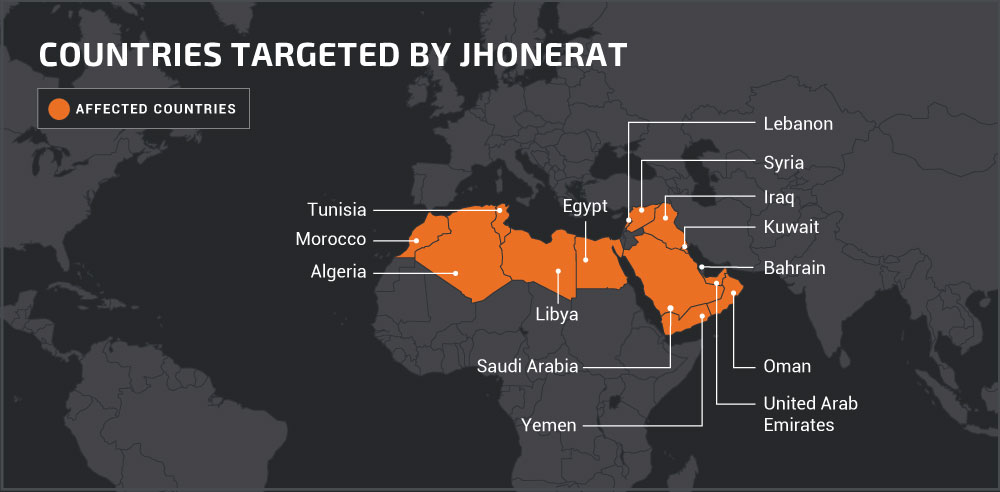
The experts discovered that the RAT is distributed via weaponized Office documents, it leverages multiple cloud services (i.e. Google Drive, Twitter, ImgBB and Google Forms) to avoid detection.
The JhoneRAT is written in Python, it attempts to download additional payloads and upload the information gathered during the reconnaissance phase.
Talos researchers identified three weaponized Microsoft Office documents that download and load an additional document containing a Macro. The first document named “Urgent.docx” is dated back November 2019.
The second document named “fb.docx” is dated January and claims to contain data on a Facebook information leak. The third document found in the mid-January pretends to be from a legitimate United Arab Emirate organization.
The additional Office documents loaded and executed by the JhoneRAT are hosted through Google Drive in the attempt to avoid URL blacklisting.
JhoneRAT is dropped through Google Drive, which hosts images with a base64-encoded binary appended at the end. Once the images are loaded onto a target machine will deploy the Trojan that harvests information from the victim’s machine (i.e. OS, disk serial numbers, the antivirus, and more).
The malware used Twitter as C2 while exfiltrates information, it checks a public Twitter feed every 10 seconds.
When communicating with its command-and-control server (C2) in order to exfiltrate information, it checks for comments every 10 seconds.
“This RAT uses three different cloud services to perform all its command and control (C2) activities. It checks for new commands in the tweets from the handle @jhone87438316 (suspended by Twitter) every 10 seconds using the BeautifulSoup HTML parser to identify new tweets.” continues the analysis. “These commands can be issued to a specific victim based on the UID generated on each target (by using the disk serial and contextual information such as the hostname, the antivirus and the OS) or to all of them.”
Experts pointed out that stolen data are exfiltrated through cloud providers, for example, screenshots are uploaded to ImgBB, while commands are executed with output sent to Forms. The malware download binaries disguised has a picture from the Google Drive and execute them.
“The attacker put a couple of tricks in place to avoid execution on virtual machines (sandbox). The first trick is the check of the serial number of the disk. The actor used the same technique in the macro and in the JhoneRAT. By default, most of the virtual machines do not have a serial number on the disk.” continues the analysis.
“The attacker used a second trick to avoid analysis of the Python code. They removed the header of the Python bytecode.”
According to the experts, the campaign is still ongoing, even if the Twitter account is suspended, attackers can easily create new accounts and use them in the same way.
“This campaign shows a threat actor interested in specific Middle Eastern and Arabic-speaking countries. It also shows us an actor that puts effort in opsec by only using cloud providers.” concludes the report. “The malicious documents, the droppers and the RAT itself are developed around cloud providers. Additionally the attackers implemented anti-VM (and sandbox) and anti-analysis tricks to hide the malicious activities to the analyst.”
The analysis report published by Talos contains additional technical details, including Indicators of Compromise.